
Talks
Computational Genomics for Microbial Traits
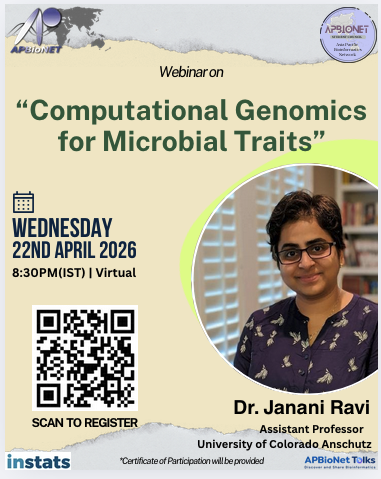
About the speaker: Dr Janani Ravi is an Assistant Professor at CU Anschutz, Department of Biomedical Informatics, Centre for Health Artificial Intelligence. With a PhD in Computational Biology from Virginia Tech and postdoctoral research at Rutgers, she joined CU in Fall 2022 from Michigan State University. Her group develops computational approaches integrating large-scale public datasets to enable mechanistic understanding of microbial genotypes, phenotypes, and diseases. Her first research aim is to understand how microbes adapt to diverse environments and how their genetic makeup relates to observable traits, using protein sequence-structure-function relationships, comparative genomics, and machine learning to bridge genotype and…
From Lab Results to Clinical Reasoning: Evaluating and Advancing AI-Driven Diagnosis, Causal Understanding and Patient Interpretation in Healthcare
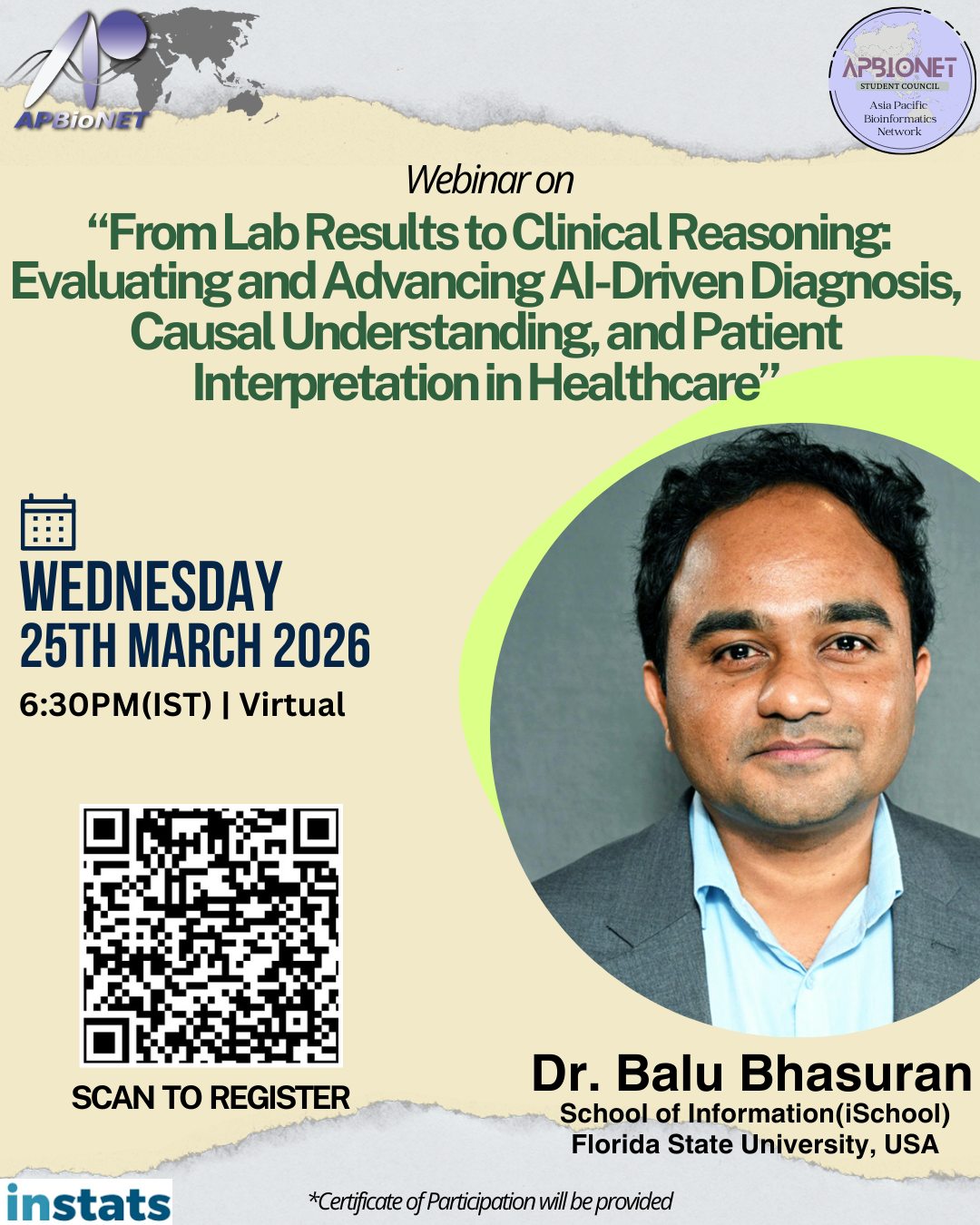
Speaker: Balu Bhasuran is a Research Faculty member at the School of Information, Florida State University, working in the eHealth Lab. His research focuses on the application of artificial intelligence, natural language processing, and large-scale clinical data to improve healthcare outcomes. He has contributed to multiple interdisciplinary studies involving electronic health records, clinical decision support systems, and large language models in medicine. Prior to this, he has been associated with leading research environments including the Bakar Computational Health Sciences Institute. Abstract: Electronic health records (EHRs) contain rich longitudinal clinical data but are difficult to mine due to class imbalance, unstructured…
Finding Antimicrobial peptides in the global microbiome using machine learning

Speaker: Luis Pedro Coelho is a group leader at the Centre for Microbiome Research at the Queensland University of Technology. His research focuses on using very large scale datasets of the global microbiome to understand microbial ecology. His group is also known for developing high-quality tools, most notably SemiBin for metagenomics binning. Before moving to Australia, Luis got a PhD from Carnegie Mellon University in the (US), worked at the EMBL in Germany, and at Fudan University in China. Abstract: Antimicrobial peptides (AMPs) are small peptides (operationally defined as those up to 100 amino acids) which kill or inhibit microbes….
Dynamic modeling of chromosomal instability in somatic genomes

Abstract: Chromosomal instability (CIN), a constantly high frequency of chromosome segregation errors during cell divisions, is a major form of genome instability and plays an import role in intra-tumour heterogeneity, metastasis, and therapy resistance. CIN often leads to structural or numerical chromosomal alterations, such as structural variants and copy number alterations. Linking these alterations detected from cancer genomics data with stochastic modelling and Bayesian inference provides a powerful approach to quantify CIN in an evolutionary context, which helps to better understand cancer evolution and inform cancer treatment. In this talk, I will share our work on modelling experimental and real…
Everything Everywhere All at Once: Lytic Polysaccharide Monooxygenases – Structure, Function, and Dynamics

Speaker: Dr. Ragothaman M. Yennamalli is a computational biologist at SASTRA Deemed to be University at Thanjavur, Taml Nadu. He has more than a decade of experience in predictive modelling and biomolecular simulation projects. Dr. Yennamalli’s skills involve machine learning, systems biology, molecular docking, molecular dynamics simulation Abstract: Cellulases are used by the biofuel industry for conversion of cellulose into glucose, which can be converted into bioethanol. While 1st generation biomass (starch and sugarcane) are currently established routes for production of bioethanol, the use of 2nd generation biomass (consisting of lignocellulose) is still in its infancy in India. Deconstruction of…
Uncovering Increasing Arbovirus Outbreaks in Subtropical South America through Genomics and Bioinformatics

Speaker: Dr. Gabriel da Luz Wallau, Oswaldo Cruz Foundation and Bernhard Nocht Institute of Tropical Medicine Moderator: Dr. Kiyoko Aoki-Kinoshita Abstract: Arthropod-borne viruses (arboviruses) are mostly vectored by mosquitoes and transmitted to humans in tropical regions of the globe. However, as extreme climatic events and climate change as a whole continues both vectors and transmitted viruses are expanding their range to previously arbovirus-free areas. Using genomic surveillance my group is mapping the spread of high impact viruses such as Dengue and Chikungunya in South America and Brazil. We developed a range of tools for rapid genome assembly and analysis of…
Sugars in the Cloud: Machine Learning and Data Science for Glycobiology

Speaker: Dr. Daniel Bojar, University of Gothenburg. Moderator: Dr. Kiyoko Aoki-Kinoshita Abstract: Glycans or complex carbohydrates are a universal yet understudied biological sequence with unique properties. The crucial role of glycans in autoimmunity, viral infections, cancer, microbiome development, and many other processes holds promise for translating a better understanding of glycan functions into biomedical advances. Dr. Bojar will present the efforts of his research group to achieve this. Developing and applying data science and machine learning methods for glycobiology has, among others, provided insight into glycan – protein interactions, glycan – immune interactions, and glycan – pathogen interactions. In a…
Applications of long read sequencing in plant genomics

Speaker: Prof. Dr. Boas Pucker, Institute of Plant Biology, TU Braunschweig Abstract: Long read sequencing revolutionized plant genomics, because even large and complex genomes became accessible. These third generation sequencing technologies are offered by Oxford Nanopore Technologies (ONT) and Pacific Biosciences (PacBio). Selected applications of these long read technologies will be presented in this talk with particular focus on the applied tools and approaches. 📅 : October 17, 2022 ⏲️ : 6 am UTC/2 pm SGT
Why social media matters for research now more than ever

Abstract: In this session, you will hear from Michelle on the increasing demand for researchers to build a digital presence with the onset of the COVID-19 pandemic and the role of social media in science communication. She will also cover examples of scientific organisations using innovative approaches to promote their research using social media, with insights on how BioExcel Centre of Excellence harnessed Twitter to build a successful computational biomolecular research community. Michelle will cover how to optimize your use of social media platforms along with “dos and don’ts” of building a digital presence. Speaker Bio: Michelle is the…
Benchmarking De novo Genome Assembly methods

COMMEMORATING THE FIRST INBIOSIS X APBioNETTALKS WEBINAR LECTURE SERIES 2021: Title : Benchmarking De novo Genome Assembly methods Date : 12 March 2021 (Friday) Time : 3 PM (Kuala Lumpur time, GMT+8) 6 PM (Sydney time, GMT+11) 2 PM (Jakarta time, GMT +7) Speaker : Prof Shoba Ranganathan (Macquarie University, Sydney)
Demo
Structural Phylogenetics

Date and Time: January, 9, 2021, 11 am – 1 pm SGT Speaker: Dr. Ashar Malik, Bioinformatics Institute, A*STAR, Singapore Abstract: The primary step in the process of characterising a novel protein sequence is by comparison with those already characterised. Similarity based functional characterisation and determination of an evolutionary origin can become a non-trivial problem for significantly diverged proteins. Protein structure, on the other hand, is considered to be conserved over longer evolutionary timescales. An evolutionary signal lost from the sequence may therefore still be retained within the conserved structure. Current times are seeing an exponential growth in protein structural…